⭐⭐⭐⭐ | May 2026 | Audiobook
🎧 Listen on Audible
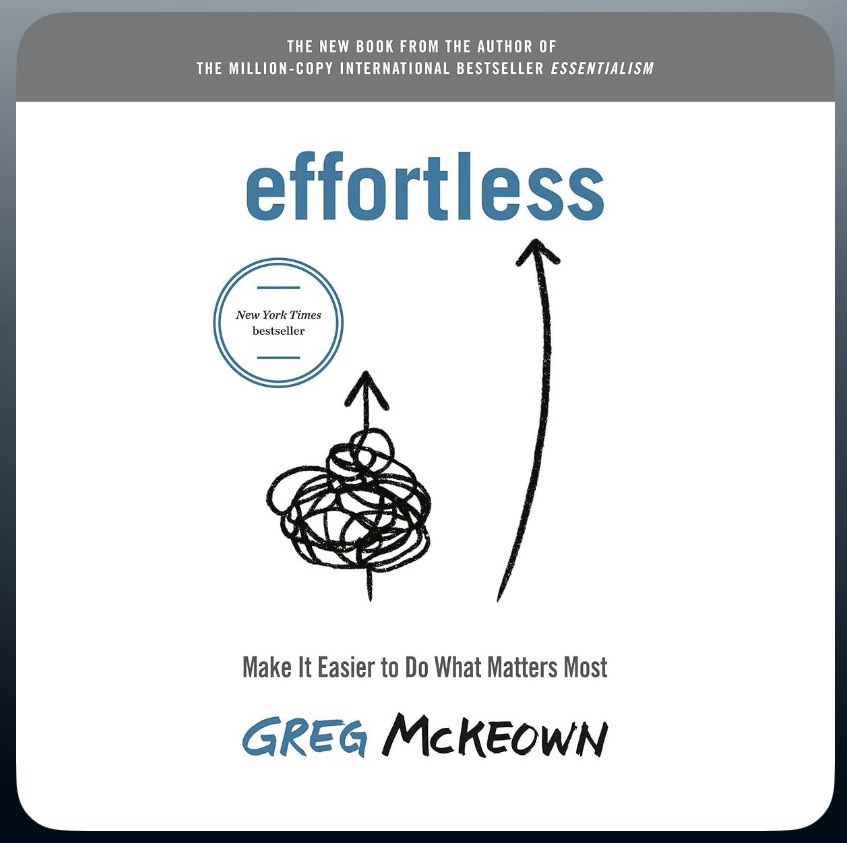
Synopsis
“Most of us believe that in order to achieve important things, we need to try harder, push further, and sacrifice more. But what if the problem isn’t your effort — it’s your approach? In Effortless, Greg McKeown, the bestselling author of Essentialism, argues that you can make the most important things easier to do by changing how you think about and approach them. From cultivating an effortless state of mind, to defining what “done” really looks like, to building residual results that compound over time, McKeown offers a practical framework for making essential work less draining, more sustainable, and ultimately more effective.”
– Synopsis paraphrased from the Crown/Currency publisher description
☕ Enjoying these notes? Buy me a coffee on Ko-fi
Opening thoughts
I picked up this book because the author was featured on The Tim Ferriss Show promoting this book. I loved his first book Essentialism as one of the best books on productivity, and apparently this book is a great follow-up and complement to that one.
From my understanding, Essentialism covers “what” to do, whereas this book covers “how” to do it — a natural and powerful pairing.
One of my themes this year is to increase my own productivity, and I felt like the insights in this book would really help with that.
Key notes
Introduction
Part I: Effortless State
- The Effortless State is one in which you are physically rested, emotionally unburdened, and mentally energized. You are completely present, attentive, and focused on what’s important in that moment — able to do what matters most with ease
Chapter 1: Invert. What If This Could Be Easy?
- We have a preprogrammed instinct to take the path of least resistance — the easiest path to get what we want
- Trying too hard makes it harder to get the results you want
- Inversion is asking: what if this could be easy?
- Solve the easiest, simplest, and most valuable problems first
- Ask: what’s the simplest way to achieve this result?
Chapter 2: Enjoy. What If This Could Be Fun?
- Make essential tasks enjoyable, which makes doing them easy
- Rituals are habits with meaning
Chapter 3: Release. The Power of Letting Go
- Gratitude is a powerful thing that starves negative emotions
- When you focus on what you lack, you lose what you have. When you focus on what you have, you get what you lack
- Hire slow and fire fast
- Accept reality as it is
Chapter 4: Rest. The Art of Doing Nothing
- Studies show that peak physical and mental performance requires a rhythm of exerting and renewing energy — and not just for athletes
- Getting more sleep may be the single greatest gift we can give our bodies, minds, and even our bottom lines
Chapter 5: Notice. How to See Clearly
- The greatest gift we can offer to others is simply us — our presence, attention, and focus
Part II: Effortless Action
Chapter 6: Define. What “Done” Looks Like
- A “done for the day” list is a list that constitutes meaningful and essential progress — not an endless to-do list, but a defined finish line
Chapter 7: Start. The First Obvious Action
- Take the minimum viable action
- We either need to make it easier to get started on what’s important now — or make it a little bit harder to do something trivial instead
Reader’s note: McKeown references two books on the power of simplifying your environment and possessions: The Life-Changing Magic of Tidying Up by Marie Kondo and Goodbye, Things by Fumio Sasaki
Chapter 8: Simplify. Start with Zero
- No matter how simple the step, it’s still easier to take no step
- Completion is infinitely better than adding superfluous steps that don’t add value
- Most geniuses prosper not by deconstructing intricate complexities, but by exploiting unrecognized simplicities
Chapter 9: Progress. The Courage to Be Rubbish
- When creating something new, don’t try to get everything exactly right the first time
- Instead, embrace rubbish — no matter how ugly — so you can crash, repair, modify, and redesign fast
- There is no mastery without mistakes
- Giving ourselves permission to fail takes courage, and it is scary
- Given that our reserves of courage are limited, we want to find ways to experience and learn from failure as cheaply as possible
- For long endeavors like writing a book, use the zero draft approach — start with a draft so rough you can’t even consider it a first draft
Chapter 10: Pace. Slow Is Smooth, Smooth Is Fast
- The false economy of powering through: it’s better to make progress at a sustainable pace than to sprint and burn yourself out
- Set an upper bound for yourself — you can achieve an effortless pace by defining not just a minimum of effort, but a maximum
Part III: Effortless Results
- With residual results, you exert effort once and reap the benefits again and again — results continue to flow whether you put in additional effort or not.
- This is as opposed to linear effort and linear results
- A lever multiplies the impact of the effort we put in
- Lever 1 — Learning: Personal capability compounds over time
- You develop a reputation once, but opportunities flow to you for years. You understand first principles deeply and can easily apply them again and again. You establish a habit once, and it’ll serve you for a lifetime
- Lever 2 — Teaching: Sharing knowledge is powerful
- Teaching other people to teach creates exponential impact. The more we teach, the more we ourselves learn
- Lever 3 — Automating: Automate something once and then forget about it as it continues to work perpetually
- Lever 4 — Trusting: If you hire the right person once, they’ll produce results hundreds of times
- Reducing friction upfront improves collaboration on all projects going forward. Building a team with transparency makes it easier to stay aligned
- Lever 5 — Preventing: Solving a problem before it happens can save you endless time and aggravation later on
- Solving a problem at its roots prevents it from resurfacing again and again. Preventing a crisis now is almost always easier than managing it in the future
- Levers can also work against you negatively if you push the wrong ones
Chapter 11: Learn. Leverage the Best of What Others Know
- Seek principles — the type of knowledge that is useful countless times
- When you understand why something happened or how something works, you can apply that knowledge again and again
- Understanding the solid fundamentals of a field allows us to anchor new information to mental models we already understand
- Prioritize reading books that have lasted a long time — the classics and the ancients — as they likely contain more timeless knowledge
- Read to absorb, not to check a box. Distill to understand
- Unique knowledge creates perpetual opportunities
Chapter 12: Lift. Harness the Strength of Ten
- Use stories to turn your audience into teachers
- When you learn to teach, you teach yourself to learn
Chapter 13: Automate. Do It Once and Never Again
- Consider taking the high-tech, low-effort path for the essential
- And take the low-tech, high-effort path for the non-essential
Reader’s note: McKeown references The Checklist Manifesto by Atul Gawande as a model for systematizing consistent, error-free execution
Chapter 14: Trust. The Engine of High-Leverage Teams
- When you have trust in your relationships, they take less effort to maintain and manage
- A low-trust relationship structure is one where expectations are unclear, goals are incompatible or at odds, people don’t know who’s doing what, the rules are ambiguous, standards for success are unknown, priorities are unclear, and incentives are misaligned
- A high-trust agreement includes: results, roles, rules, resources, and rewards
Chapter 15: Prevent. Solve the Problem Before It Happens
- It usually takes less time to prevent a problem than to solve it
- To start, find the most annoying thing you can solve in the least amount of time or effort
- Instead of hacking at the branches, strike at the root
- Measure twice and cut once
Conclusion: Now. What Happens Next Matters Most
Closing thoughts
I loved this book! There were a lot of great insights and takeaways, especially on productivity. Not necessarily new ideas in isolation, but putting them all into a cohesive framework with actionable items makes this read very valuable to anyone looking to do their best work without burning out.
One takeaway / Putting into practice
This entire book has so many great takeaways, and my notes above include my favorites. However, I’m going to cop out for once and give two answers for my “one takeaway” but in two separate categories.
Mindset: When you focus on what you lack, you lose what you have. When you focus on what you have, you get what you lack.
- This line from Chapter 3 is one of the most powerful reframes in the book. Gratitude isn’t just a feel-good practice — it’s a strategic one. At the end of each day this week, write down one thing you already have that is working for you — and notice how your energy and perspective shift
Tactical: Build residual results, not just linear ones.
- The highest-leverage question you can ask yourself is: where can I exert effort once and reap benefits again and again? This is the difference between a good day and a good decade. Identify one lever — something to learn deeply, a system to automate, a person to trust with more responsibility, or a recurring problem to solve at the root — and invest in it this week.
- Some of my most powerful and high-leverage habits/behaviors/systems were ones I put in place a long time ago (some over 10+ years), and the effort I put in then have given me the most returns until today.
Nutshell
Greg McKeown’s follow-up to Essentialism asks not just what to focus on, but how to do it without burning out — by cultivating an effortless state of mind, simplifying action down to its essentials, and building residual results that compound over time. Where Essentialism defines what matters most, Effortless gives you the tools to make doing it feel less like a grind and more like a natural flow.
Similar books
- Essentialism by Greg McKeown — The essential predecessor: if Effortless is the “how,” Essentialism is the “what” — identifying and committing only to what matters most
- Deep Work by Cal Newport — A compelling case for doing your most important work with intense, undistracted focus; pairs perfectly with Effortless’s framework for reducing friction
- Ultralearning by Scott Young — On the power of strategic, high-leverage learning — highly complementary to the “Learn” lever in Part III
- The Life-Changing Magic of Tidying Up by Marie Kondo — Applies the same “start with zero” and simplicity principles to your physical environment; referenced by McKeown in Chapter 7
- The Checklist Manifesto by Atul Gawande — A masterclass in systematizing consistent, effortless execution through the power of a simple checklist; referenced by McKeown in Chapter 13
Rating
⭐⭐⭐⭐
4 / 5
Subscribe for More Summaries👇
Try Audible for audiobooks 📚🎧
Personal recommendation: For the last 10+ years, I’ve used Audible to listen to all of my favorite books. It’s easy to use, cost-effective, and they have the best library of audiobooks.
If you use my affiliate links below, not only will you get a special offer, but it’ll help support the costs to maintain this blog! 😊👇
Try Audible and Get Two Free Audiobooks

Please donate! 🙂
Please consider a small donation to help support my blog ^_^ I love providing free book notes and other content. Any donations help me maintain my website and create content consistently. Thanks everyone for the continued support!
$2.00
Discover more from Marlo Yonocruz
Subscribe to get the latest posts sent to your email.
