Get the audiobook on Audible 👇 (affiliate link)
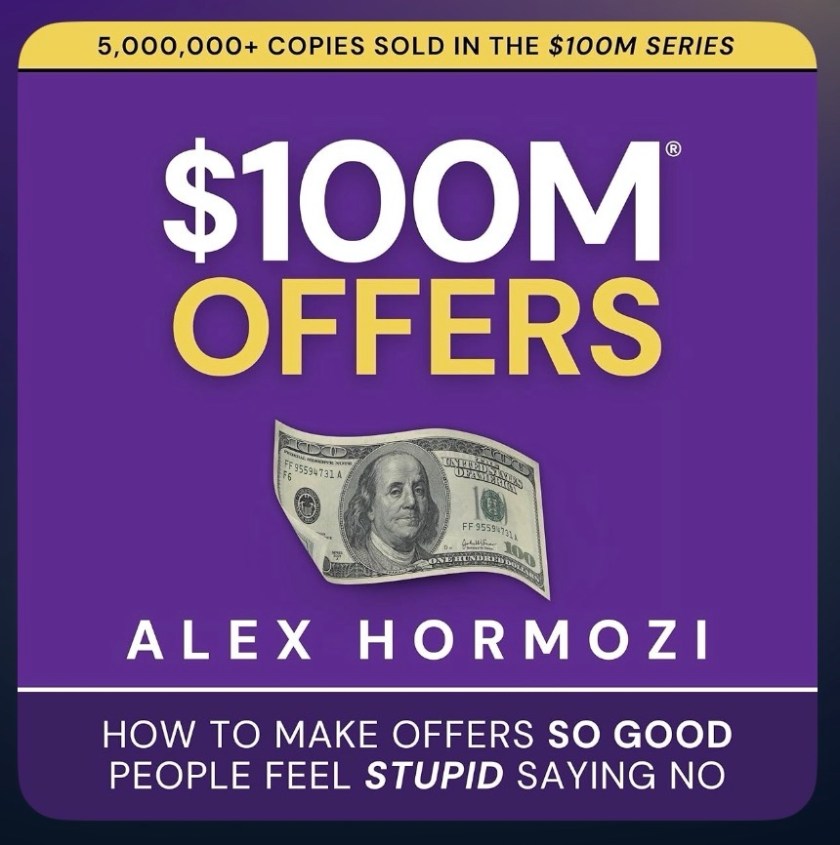
$100M Offers: How to Make Offers So Good People Feel Stupid Saying No by Alex Hormozi
Date read / Format:
January 2026 | Audiobook
Synopsis:
“I took home more in a year than the CEOs of McDonald’s, IKEA, Ford, Motorola, and Yahoo combined as a kid in my 20s using the $100M Offers method. It works. And it will work for you.
Not that long ago, though, my business had gotten so bad that I literally couldn’t even give my services away for free. At the end of each month, I would look at my bank account hoping to see progress (but there wasn’t). I knew something had to change…but what?
Over the next 48 months, I went from losing money to making $36 for every $1 spent. In that time period, we generated over $120,000,000 across four different industries: service, ecommerce, software, and brick and mortar.
But, unlike everyone else, we didn’t have great funnels, great ads, or a wealthy niche. In fact, we didn’t even send emails until we had crossed $50M in sales. Instead, we were able to do this one thing really well: We created offers so good, people felt stupid saying no.
Here’s exactly what this book will show you how to do:
- How to charge a lot more than you currently are
- The tiny market, big money process we use to laser focus on niche markets overflowing with cash
- The “unfair” pricing formula: How we multiplied our pricing by 100 (and got more people to say yes…for real)
- The value flip…so you never get price compared again (That’s a promise.)
- The virtuous cycle of price: Use it to outspend your competition (for good) while using your product to attract the best talent.
- How to make your product so good, prospects find a way to pay for it
- The unbeatable value equation: to make what you sell worth more than your prospects have ever received
- The delivery cube: to make delivering your products and services cost less but provide more
- The trim and stack hack: to maximize profit using the absolute best delivery methods. (This has never been shared publicly and was how we made $17m in profit on $28m in revenue in a year when I was 28 years old)
- How to enhance your offer so much, prospects buy without hesitating
- The scarcity stack: How to use the three different types of scarcity in every offer you make (without lying) to get people to buy the moment you ask
- The “everyday” urgency blueprint: to get prospects to buy right now, using everyday life to create real, ethical time pressure
- Unbeatable bonuses…and watch your prospects’ hesitations melt away as they begin reading their credit cards to you before you even finish!
- God-mode guarantees: So good they make anyone say yes (even people who would never normally consider buying). I’ll show you how to stack and layer all four types of guarantees together. I even give you my 13 favorite guarantees word-for-word to swipe for yourself.
- Magic naming formula to get the absolute highest response rates and conversion rates from everything you do to get new clients
- And so much more
The methods contained within this book are so simple, so instantaneous, and so effective, it’s as if they work by magic. If you implement even one tactic in this book, you’ll see the change in your prospects’ demeanor. And you’ll know the $100M Offers method worked when you start hearing, “What do I need to do to move forward?” before you even ask for the sale.” -Audible
~If you enjoy my summary, please consider buying me a coffee via my Ko-Fi link (click the button below) or support this blog in one of several ways! 📖 🎓
I appreciate every donation as it goes directly to the maintenance costs of my blog and creation of new content. 😊

Opening thoughts:
This book was recommended by Ali Abdaal, who listed it as one of his top 4 business and entrepreneurship books for creating financial success — high praise from someone whose content on productivity and entrepreneurship I’ve followed for years. On top of that, a good friend of mine, Lorenzo Aromin (featured on OTG Episode 66), also recommended it, so I figured it was time to dive in.
Key notes:
Chapter 1: How We Got Here
Chapter 2: Grand Slam Offers
- The secret to sales: make people an offer so good they feel stupid saying no.
- The only way to conduct a business is through a value exchange
- You initiate this with an offer — the goods and services you’ve agreed to provide, how you accept payments, and the terms of your agreement. It’s how you begin the process of making money.
Chapter 3: Why Businesses Fail (Pricing)
- 3 ways to grow a business:
- Get more customers
- Increase the average purchase volume
- Get them to buy more times
- A Grand Slam Offer is what you present to the marketplace that cannot be compared to any other product or service available — combining an attractive promotion, an unmatchable value proposition, a premium price, and an unbeatable guarantee, using a money model that allows you to get paid to get new customers, forever removing the cash restraint on business growth.
- Being in a category of 1 or in a vacuum forces the client to shift from a commodity-driven to a value-driven perspective of your offer.
Chapter 4: Finding the Right Market (Pricing)
- The value of a starving crowd is you’ll make money regardless of how good your offer is.
- Don’t try to create demand — channel it
- Most markets fall into one of the 3 common unmet needs categories: improved health, wealth, or relationships.
- 4 factors for your market:
- identifiable pain points
- purchasing power
- easy to target
- growing market
- For most businesses under $10M in revenue, niching down and focusing your offer on your specific target audience is the right path forward.
- 1) Don’t pick bad markets
- 2) Commit until you figure it out.
Chapter 5: Charging What It’s Worth (Pricing)
- Premium pricing is the best way to go — not only to support your business’s mission long-term, but to deliver more value for the customer
- Higher pricing creates higher perceived value by the customer, as well as more emotional investment on their end to actually follow through.
- The gap between what they pay — even at premium pricing — and what they get should be massive.
Chapter 6: Value — The New Paradigm
- You should charge 100x more for your product than it costs to fulfill — but it should still be a steal for your prospect because it adds tremendous value
- The Value Equation: Dream Outcome × Perceived Likelihood of Achievement ÷ Time Delay × Effort & Sacrifice = Value
- Perception is reality. It’s all about your prospect’s perception of these 4 key variables.
- Pro tip: Logical vs. psychological solutions
- Most people try logical solutions, but they’ve already been tried
- Try to find psychological solutions instead.
Reader’s note: In this section, he describes logical solutions as efficiency/engineering approaches (i.e., making things faster or objectively better), as opposed to psychological solutions that use creativity to improve the customer experience — like things that distract from wait times or make the experience more pleasant overall.
- It’s up to the business owner to communicate the value drivers with clarity to increase the prospect’s perception of these realities.
- Talk in terms of things your prospect believes will increase their status
- Pro tip: Frame benefits in terms of status gained from the viewpoint of others.
- People pay for and value certainty.
- Communicate perceived likelihood of achievement through messaging, proof, what you choose to include/exclude in your offers, and guarantees
- The thing people buy is the long-term value (dream outcome), but the thing that makes them stay long enough to get it is the short-term experience — the little milestones along the way that show they’re on the right path
- Try to tie as many of these as possible into any service you offer
- Get your client a big emotional win early, as close as possible to the purchase.
- Pro tip: Fast wins
- Always incorporate short-term, immediate wins for your clients
- Be creative — they just need to know they’re on the right path and made the right decision trusting you
- Pro tip: Fast beats free
- The only thing that beats free is fast. People will pay for speed
Chapter 7: Free Goodwill
- People who help others with zero expectation experience higher levels of fulfillment, live longer, and make more money.
Chapter 8: The Value Offer — The Thought Process
- Convergent thinking: having multiple variables but only one right answer
- Divergent thinking: coming up with multiple solutions where one is more right than the others — this is the problem-solving mode you want for offer creation
Chapter 9: Value Offer Creation (Steps 1–4)
- Step 1: Identify a dream outcome
- Don’t sell a membership — sell a solution.
- Step 2: List problems
- Think about what happens immediately before and after they use your product.
- What’s the next thing they need help with?
- Think about it in insane detail — you’ll continually be answering people’s next problem as it manifests.
- List out the core things your prospect needs to do, and all the problems they’ll have or reasons they won’t be able to do it or keep doing it
- The more problems you can think of, the more problems you can solve.
- From your list of problems, create a list of solutions and name them
Chapter 10: Value Offer Creation (Step 5: Trim and Stack)
- Create flow, monetize flow, then create friction
- Generate demand first, then get them to say yes with your offer
- Then add friction in marketing or offer less for the same price.
- The “how”: Think about anything you can possibly do — all the things that might enhance the value of your offer — so much so that it would be stupid to say no
- Don’t get romantic about HOW you want to solve a problem
- Find a way to solve every problem a prospect presents. Then you’ll make an offer so good they can’t say no
- Step 5: Trim and stack — trim those ways down to the highest value and lowest cost to deliver.
- The bundle model works because:
- It solves all perceived problems, not just some
- Gives you conviction that what you’re selling is one of a kind
- Makes it impossible to compare or confuse your offering to the one down the street.
- Scarcity, urgency, bonuses, and guarantees are the core persuasion tools to raise value in your offer.
Hormozi’s Law: “The longer you delay the ask, the bigger the ask you can make. The longer the runway, the bigger the plane that can take off. You must keep the supply and satisfaction of desire under the demand that you’re able to generate. This maximizes profits and keeps desire ravenous in your customer base.”
Chapter 11: Scarcity
- Premium prices are made from simple supply and demand
- The person who needs the exchange less always has the upper hand.
- 3 types of scarcity:
- limited supply of seats/slots in general or over a period of time
- limited supply of bonuses
- never available again.
- Always sell out your stock, and let your customers know you sold out — as social proof that it’s valuable, and to drive desire for it next time it’s available
- For service businesses: leverage the model of “only accepting X clients” at this level of service
- This caps clients served but keeps them in. You create a waiting list for new prospects — when your door opens, they jump right in, and price resistance disappears
- For service businesses: leverage the model of “only accepting X clients” at this level of service
- Always have fewer spots available than you think you can sell — so that next time, everyone remembers you sold out fast.
- Pro tip: Create a very exclusive service tier based on access to you, cap it at a tiny number, price it very high, then tell people
Chapter 12: Urgency
- Deadlines drive decisions
- Scarcity is a function of quantity; urgency is a function of time.
- 4 ways to use urgency:
- Rolling cohorts
- Rolling seasonal urgency
- Promotional or pricing urgency
- Exploiting opportunity.
- Pro tip: Clean your pipeline with every price change
- Never raise your prices without letting people know first — it shows a position of strength and generates an influx of cash from pipeline prospects who are on the fence
Chapter 13: Bonuses
- A single offer is less valuable than the same offer broken up into its component parts and stacked as bonuses
- Pro tip: Add bonuses instead of discounting on core offers whenever possible
- Key rules when offering bonuses:
- Always offer bonuses
- Give each a special name with the benefit in the title
- Tell them: a) how it relates to their issue, b) what it is, c) how you discovered or created it, d) how it will improve their lives or experience
- Provide proof
- Paint a vivid mental image of life after using it
- Always assign a price tag and justify it
- Tools and checklists beat additional trainings — lower effort and time required
- Each bonus should address a specific obstacle in the prospect’s mind and prove their limiting belief incorrect
- Bonuses can also solve the prospect’s next logical problem before they encounter it
- The value of bonuses should eclipse the value of the core offer
- You can further enhance bonuses by adding scarcity and urgency to the bonuses themselves.
- Key rules when offering bonuses:
Chapter 14: Guarantees
- The single greatest objection is always risk. Therefore, reversing risk is the fastest way to make an offer more attractive
- 4 types of guarantees:
- unconditional
- conditional
- anti-guarantee
- implied guarantee
Chapter 15: Naming
- Refreshing offer names can extend the lifetime of the offer and overcome offer fatigue
- MAGIC headline formula: Magnet, Avatar, Goal, Interval, Container — roughly translating to: Attention, Discrimination, Purpose, Timeline, and Method.
- Pro tip: Name your sub-items and bonuses.
- Use your entrepreneurial ADD on your wrapper first (copy, creative, headlines), then change the seasonality of the offer, then the duration
- If stuck, change what you’re giving away for free or discounted
- Change the entire machine behind it only as a last resort and for good reason.
Closing thoughts:
Absolutely loved this one. Alex Hormozi is incredibly straight to the point — no fluff, just high-value tactical advice. A lot of what he covers changed the way I think about starting and running a business, not just how to craft a great offer. And I’ve actually started implementing some of these ideas in my own coaching business over the last couple of months. Highly recommend for any entrepreneur at any stage.
One Takeaway / Putting into practice:
The Value Equation: Value = (Dream Outcome × Perceived Likelihood of Achievement) ÷ (Time Delay × Effort & Sacrifice). This single framework reframes everything about how you position, price, and present what you sell. To increase value, you can increase the dream outcome or the perceived likelihood of success — or decrease the time to results and the effort required. The best Grand Slam Offers do all four at once.
Nutshell:
$100M Offers is a tactical playbook for entrepreneurs who want to stop competing on price and start winning on value. Hormozi breaks down the exact process for crafting a “Grand Slam Offer” so compelling your ideal client would feel foolish saying no.
Similar books:
- The Personal MBA by Josh Kaufman
- Million Dollar Weekend by Noah Kagan
- Crush It! by Gary Vaynerchuk
- The Conversion Code by Chris Smith
- The Soulful Art of Persuasion by Jason Harris
- Pitch Anything by Oren Klaff
Rating:
4.5/5
Subscribe for More Summaries👇
Try Audible for audiobooks 📚🎧
Personal recommendation: For the last 10+ years, I’ve used Audible to listen to all of my favorite books. It’s easy to use, cost-effective, and they have the best library of audiobooks.
If you use my affiliate links below, not only will you get a special offer, but it’ll help support the costs to maintain this blog! 😊👇
Try Audible and Get Two Free Audiobooks

Please donate! 🙂
Please consider a small donation to help support my blog ^_^ I love providing free book notes and other content. Any donations help me maintain my website and create content consistently. Thanks everyone for the continued support!
$2.00
Discover more from Marlo Yonocruz
Subscribe to get the latest posts sent to your email.
