Get the audiobook on Audible 👇 (affiliate link)
Just Listen: Discover the Secret to Getting Through to Absolutely Anyone by Mark Goulston, MD
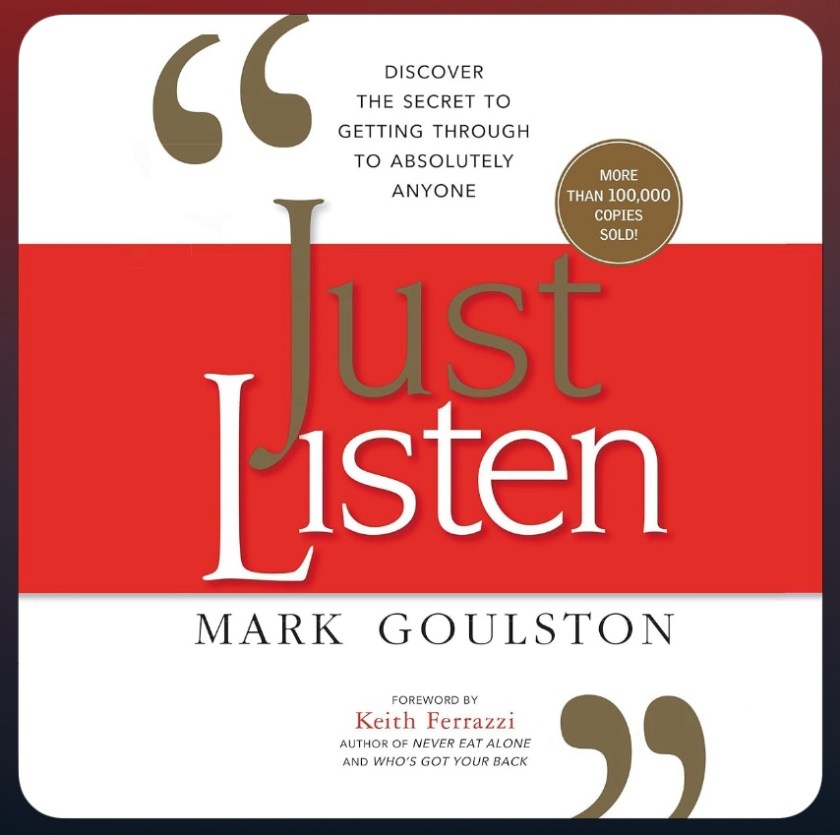
Synopsis:
“Drawing on his experience as a psychiatrist, business consultant, and coach, author Mark Goulston combines his background with the latest scientific research to help listeners turn the “impossible” and “unreachable” people in their lives into allies, devoted customers, loyal colleagues, and lifetime friends. Just Listen provides simple but powerful techniques listeners can use to really get through to people.
You’ll learn how to: make a powerful and positive first impression; listen effectively; make even a total stranger (potential client) feel understood; talk an angry or aggressive person away from an instinctual, unproductive reaction and toward a more rational mindset; and achieve buy-in – the linchpin of all persuasion, negotiation, and sales.
Whether they’re coworkers, friends, strangers, or enemies, the first make-or-break step in persuading anyone to do anything is getting them to hear you out. With this groundbreaking audiobook, listeners will be able to master the fine but critical art of effective communication.” -Audible
~If you enjoy my summary, please consider buying me a coffee via my Ko-Fi link (click the button below) or support this blog in one of several ways! 📖 🎓
I appreciate every donation as it goes directly to the maintenance costs of my blog and creation of new content. 😊

Opening thoughts:
I’m not sure where I got this book recommendation from, but if I had to guess it was from Audible. I feel like I wanted to read a book this month about people skills, and this seemed like exactly what I was looking for.
Key notes:
Section One: The Secret to Reaching Anyone
1. Who’s Holding You Hostage?
The Persuasion Cycle
- You get through to people by having them buy-in
- This occurs when people move from resisting to listening to considering what you’re saying
The Secret: Getting Through Is Simple
- Reaching an unreachable person requires talking to the brain
2. A Little Science: How the Brain Goes from “No” to “Yes”
The Three-Part Brain
- The three parts of the brain are focused on fight or flight, primal emotions, and logic
Amygdala Hijack and the Death of Rational Thought
Mirror Neurons
- Mirror neurons form the basis of empathy
- We constantly mirror the world, conforming to its needs, and trying to win its love and approval
- And each time we mirror the world, it creates a little reciprocal hunger to be mirrored back. If that hunger isn’t filled, we develop what he refers to as “mirror neuron gap”
- This gap explains why we feel so overwhelmed when someone acknowledges either our pain or our triumphs
- Accurate mirroring helps the person to feel less alone, and therefore feel some relief and mentally able to relax a bit and be more open
- Understanding a person’s hunger and responding to it is one of the most potent tools that you’ll ever discover getting through to anyone you meet
From Theory to Action
Section Two: The Nine Core Rules for Getting Through to Anyone
3. Move Yourself from “Oh F*** to OK”
Get Through to Yourself First
Speed is Everything
The “Oh F*** to OK” Process
- When you put words to your emotions, the amygdala cools down almost instantly
The Power of “Oh F***”
The “Oh F*** to OK” Speed Drill
4. Rewire Yourself to Listen
- Our brains are far better at leaping to conclusions than at stepping back to analyze them
“But I Do Listen! …Don’t I?”
How Well Do You Know the People You Know?
- You probably know a lot less about the people you’re trying to reach
- If you want to open the lines of communication, open your own mind first
- Schedule a lunch or meeting with the problem person and see if you can uncover the real reason behind their behavior
5. Make the Other Person Feel “Felt”
Why Does “Feeling Felt” Change People?
- It simply means putting yourself in another person’s shoes
The Steps to Making Another Person Feel “Felt”
6. Be More Interested Than Interesting
- Nearly everyone has an interesting story to tell
The “Interesting” Jackass
Don’t Just Act Interested – Be Interested
- Think of a conversation as a detective game in which the goal is to learn as much about the other person as you can
- Go into the conversation knowing there is something very interesting about the person and be determined to discover it
- “How’d you get into what you do?”
- “What do you like best about it? What are you trying to accomplish that’s important to you, and why?”
- “What’s the best or worst parts of ___?”
- “Who’s the person who’s had the biggest influence on your life? Is that who you’re most grateful to? If not, who is? Have you ever thanked them?”
- Giving people the chance to speak about who they’re grateful to brings out the best in them
- “Imagine the world is perfect. What do you see?”
- Show you’re listening by repeating back some of what they say and summarizing
- Ask for advice if you get the opportunity
Everyone has an invisible sign hanging around their neck saying ‘make me feel important’ -Mary K Ash
7. Make People Feel Valuable
- Obvious truth: People need to feel valuable
- We need to see our worth reflected in the eyes of the people around us
- This is different from making them feel felt, or feel interesting
- We need to see our worth reflected in the eyes of the people around us
- Lesson: The good people in your life need and deserve reassurance that they’re valued
- The annoying people in your life may not deserve it but they need it even more
- Insight: Everyone competes for time but nobody should need to compete for importance
8. Help People to Exhale Emotionally and Mentally
Moving a Person Away from Distress
- Allowing someone to exhale helps them to emotionally calm down but also build a mental bridge between you two
Guiding a Person to Exhale
- Getting someone to uncross their arms physically can help them uncross their arms mentally and open up more
- The best thing to do when someone is venting, whining, or complaining is to avoid interrupting
- Don’t take issue with anything they say, become defensive, or get into a debate
- After venting, you’ll both be exhausted
- This is not the same as relaxed, as it is more a feeling of being empty and tired and not open to input
- It may seem like the moment to talk, but it is not
- Instead, pause, and ask them to tell you more
- If you’re trying to get through to someone who is suppressing their feelings, ask “ Have I ever made you feel like I don’t respect you? Have I ever made you feel like you weren’t worth listening to?”
- Don’t interrupt the person or get defensive. Let the person vent and exhale
9. Check Your Dissonance at the Door
- Dissonance: When you think you’re coming across one way, but people see you in a totally different way
- The single greatest cause of dissonance is the fact that people behave their worst when they feel most powerless
- The way to reconcile dissonance is to ask people who are close to you and are honest or blunt how they feel about you
The Perils of Corporate Dissonance
When You Can’t Avoid Dissonance, Anticipate It
- Preemptive dissonance diffusing: apologizing and asking for grace in advance for any cultural mishaps and miscommunications while promising your very best to avoid mistakes
- Don’t be afraid to share your vulnerabilities
- It doesn’t make you weak, it makes you accessible
10. When All Seems Lost – Bare Your Neck
Show Them Your Neck, and They’ll Want to Show You Theirs
- Action step: The next time you’re afraid or in distress, don’t pretend that you’re not. Identify the people you’re trying to hide your emotions from, and then tell them the truth
- If you suspect someone else is afraid or in distress, encourage them to tell you about it. Then let them know you respect them for opening up and admitting their fears and mistakes
11. Steer Clear of Toxic People
Needy People
- Evaluate your relationships from low to high-maintenance
Bullies
Takers
- Identify takers ahead of time and have a request/ quid pro quo ready to ask of them
- It’ll prevent you from getting mad or having to say no, and thus you don’t create an enemy, and they’ll slowly back off
Narcissists
- Set your expectations so that you’re not blindsided by the self-serving motives of a narcissist
Psychopaths
- Core traits of a psychopath: coldness, lack of empathy, self-centeredness, ruthlessness
- These can make them some of the wealthiest business leaders
Mirror Check: Who’s the Problem?
Section Three: 12 Easy-to-Use Tools for Achieving Buy-In and Getting Through
12. The Impossibility Question
- 2 questions:
- What’s something that would be impossible to do, but if you could do it, would dramatically increase your success?
- What would make it possible?
13. The Magic Paradox
The Cascade of “Yes”
A Trust-Gaining Move
- If you want people to do the unexpected, you go first
14. The Empathy Jolt
How It Works
- Anger and empathy cannot exist in the same place at the same time
- When you shift a blamer into empathy, you stop their empty ranting
When to Employ the Empathy Jolt
- Listen and facilitate but don’t butt in with your own thoughts
- The goal is to have them mirror each other
The Power of Analogy
15. The Reverse Play, Empathy Jolt #2
16. “Do You Really Believe That?”
17. The Power of “Hmmm…”
- Don’t get defensive, go deeper
18. The Stipulation Gambit
- Show poise by openly expressing the misgivings people have about you. They’ll be more likely to give you their positive and undivided attention
- If you know there’s something about you that makes other people uncomfortable, practice ways to describe what the problem is and how other people can respond to it
19. From Transaction to Transformation
Negotiating Versus Relating
What Question Would Make You Look Up?
20. Side by Side
- Questioning works better than telling
- When you ask people questions, respect their answers
- If they offer a good idea, act on it and let them know that you did
- Even if they’re off base, acknowledge their remarks
- If they offer a good idea, act on it and let them know that you did
21. Fill In the Blanks
22. Take It All the Way to “No”
- Until someone says no to you, you’re not asking for enough
23. The Power of Thank You and Power Apology
“9/10ths of wisdom is appreciation”
“Thank You” Versus the Power Thank You
- Offer a power thank you if you’re deeply grateful for someone who has done an exceptional favor for you
- Part 1 – thank them for something specific they’ve done
- Part 2 – acknowledge the effort it took for them to help you
- Part 3 – tell the person the difference that their act personally made to you
- To make it more powerful, offer these in a group setting
The Power Apology
- Power apology has 4 Rs:
- Remorse
- Restitution
- Rehabilitation
- Request forgiveness
- Don’t ask immediately, but wait until your actions follow your words
- Action: Give the people who have helped you the most a power thank you, and the people you’ve hurt a power apology
- It’s never too late to give either
Section Four: Fixes for Seven Challenging Situations
24. The Team from Hell
- Break down silos in teams by building on the things all silos have in common: the sky above (a shared vision) and the ground below (shared values)
- Assemble the best team you can, and then become the person that they and you would want to lead them
25. Climbing the Ladder
- Visualize yourself in the job that you want and then actively plan to get there
- List the people you most admire and plan to try and get closer to them and position them as a mentor
26. The Narcissist at the Table
- Make as little room as possible for narcissists and try your best to cut them out of your life
27. Stranger in Town
The Visibility Stage
The Credibility Stage
The Profitability Stage
- Focus on what’s in it for them and reciprocators will ask, “What can I do for you?”
28. The Human Explosion
- If someone can’t or won’t listen to you, get them to listen to themselves
29. Getting Through to Yourself
30. Six Degrees of Separation
Create One-on-One Situations
Make Virtual Allies
Reach the Gatekeepers
Closing thoughts:
Wow. This was one of the best and most impactful self-improvement books on people skills I’ve read in a long time. Easily my top 10 or top 5 in this category.
The hallmark of a great personal development book for me is how insightful the ideas are, how actionable the advice the author gives, and how much it changes my previous conception of the topic once I finish reading the book. For me, it definitely shifted the way I see certain aspects of navigating people and relationships, beyond what I’ve read from other books covering the same topics.
Some of the ideas I’ve learned in this book I’m still applying today (7 months after finishing the book), and have even used in my new podcast I launched in October this year. Because of that, I have to admit that this book has made an impact on my way of thinking.
Overall, highly recommend this book! I feel like this is one of those books that everyone should read at least once a year, myself included.
One Takeaway / Putting into practice:
Although there are a TON of great takeaways in this book, the one that stuck with me the most and gave me that “ah ha!” lightbulb/epiphany moment was this:
- We constantly mirror the world, conforming to its needs, and trying to win its love and approval. And each time we mirror the world, it creates a little reciprocal hunger to be mirrored back. If that hunger isn’t filled, we develop what he refers to as “mirror neuron gap.” This gap explains why we feel so overwhelmed when someone acknowledges either our pain or our triumphs
This point hit home because I feel like we can all relate to that moment when we feel that tension buildup after feeling like our efforts aren’t being seen or appreciated. Then, when someone acknowledges us, our efforts, and our feelings, it’s like letting the floodgates open and our emotions get a chance to release. A few times I’ve broken down this year is when I felt acknowledged and appreciated for my efforts. This emotional impact made the idea really stick with me throughout this year.
Nutshell:
An extensive guide to navigating people, improving relationships, and getting through to anyone.
Similar books:
- The Like Switch by Jack Schafer
- Captivate by Vanessa Van Edwards
- Dare to Lead by Brene Brown
- The Soulful Art of Persuasion by Jason Harris
- Never Eat Alone by Keith Ferrazzi
- Twelve and a Half by Gary Vaynerchuk
- You’re Not Listening by Kate Murphy
- Nonviolent Communication by Marshall Rosenberg
Rating:
4.5/5
Subscribe for More Summaries👇
Try Audible for audiobooks 📚🎧
Personal recommendation: For the last 10 years, I’ve used Audible to listen to all of my favorite books. It’s easy to use, cost-effective, and they have the best library of audiobooks.
If you use my affiliate links below, not only will you get a special offer, but it’ll help support the costs to maintain this blog! 😊👇
Try Audible and Get Two Free Audiobooks

Please donate! 🙂
Please consider a small donation to help support my blog ^_^ I love providing free book notes and other content. Any donations help me maintain my website and create content consistently. Thanks everyone for the continued support!
$2.00
Discover more from Marlo Yonocruz
Subscribe to get the latest posts sent to your email.
