Get the audiobook on Audible 👇 (affiliate link)
The Dichotomy of Leadership: Balancing the Challenges of Extreme Ownership to Lead and Win by Jocko Willink & Leif Babin
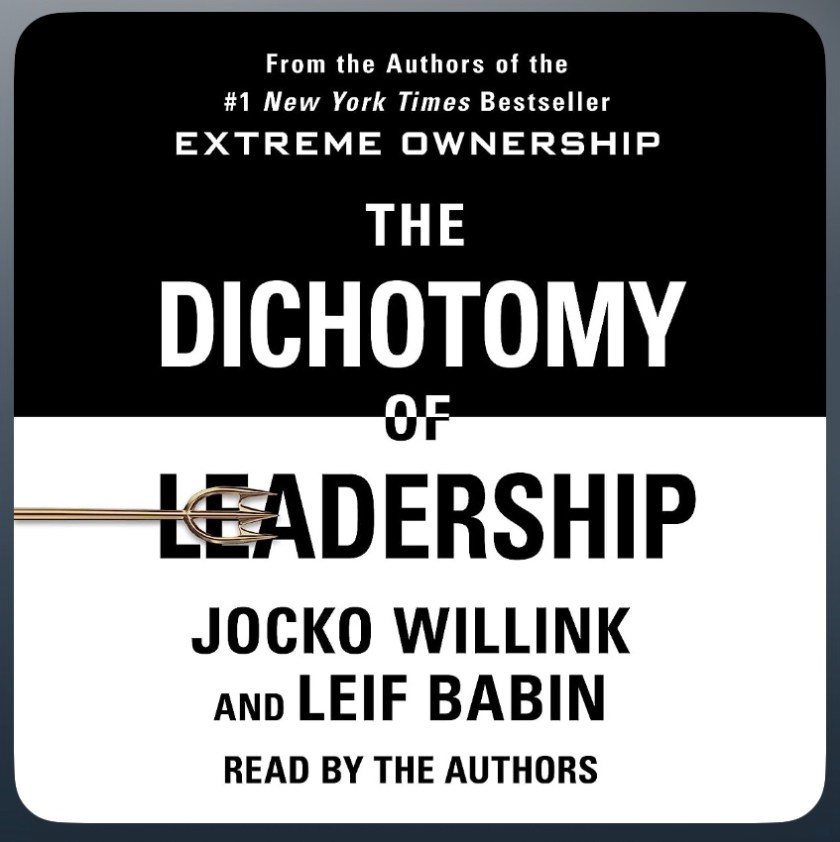
Synopsis:
“Every leader must be ready and willing to take charge, to make hard, crucial calls for the good of the team and the mission. Something much more difficult to understand is that in order to be a good leader, one must also be a good follower. This is a dichotomy – a Dichotomy of Leadership. It is, as authors Jocko Willink and Leif Babin explained in their best-selling first audiobook, Extreme Ownership, “Simple, Not Easy”.
Now, in The Dichotomy of Leadership, the authors explain the power inherent in the recognition of the fine line that leaders must walk, balancing between two seemingly opposite inclinations. It is with the knowledge and understanding of this balance that a leader can most effectively lead, accomplish the mission, and achieve the goal of every leader and every team: victory.
Using examples from the authors’ combat and training experience in the SEAL Teams and then showing how each lesson applies to business and in life, Willink and Babin reveal how the use of seemingly opposite principles – leading and following, focusing and detaching, being both aggressive and prudent – require skill, awareness, understanding, and dexterity, all attributes that can be honed. These dichotomies are inherent in many of the concepts introduced in Extreme Ownership and integral to their proper implementation and effectiveness. Dichotomy is essential listening for anyone looking to lead and win.” -Audible
~If you enjoy my summary, please consider buying me a coffee via my Ko-Fi link (click the button below) or support this blog in one of several ways! 📖 🎓
I appreciate every donation as it goes directly to the maintenance costs of my blog and creation of new content. 😊

Opening thoughts:
I’m actually looking forward to this book. When I saw that these two had a follow up book to Extreme Ownership, I almost immediately put it on my to-read list. I really enjoyed that first book as it was very impactful and insightful. It really changed the way I thought about leadership in particular. I’m curious what else this book will add to the conversation, and how it’s different or similar to the first book.
Key notes:
- The purpose of this book is to further expand on the ideas in Extreme Ownership, particularly the balance needed in leadership
- Both opposing forces are needed but the balance between the two is needed
Introduction: Finding the Balance
- The goal of all leaders should be to work themselves out of a job
- By putting junior leaders in charge, the group as a whole becomes more effective
- Leadership isn’t actually extreme, it requires balance
Part 1: Balancing People
Chapter 1: The Ultimate Dichotomy
Principle: The most difficult dichotomy to balance is caring deeply about the team but also accepting the risks necessary to accomplish the mission
Chapter 2: Own It All, but Empower Others
- Extreme ownership means you’re responsible for everything as a leader, but doesn’t mean you have to do everything yourself
- This is the importance of decentralized command
Principle: Micromanagement doesn’t work because no one person can control every person and action in a team, and it stifles leadership growth
- The hands-off leader fails to provide the necessary direction
- People start to get off track from the greater goals and mission of the team
Chapter 3: resolute but not overbearing
Principle: Leaders can’t be too lenient but also can’t be too overbearing
Chapter 4: When to Mentor, When to Fire
Principle: Most underperformers don’t need to be fired, they need to be led. But once every effort has been made to help them improve and all efforts have failed, a leader has to make the tough call to let them go
Part 2: Balancing the Mission
Chapter 5: Train Hard but Train Smart
- While training must make the team and especially leaders uncomfortable, it cannot be so overwhelming that it diminishes the lessons learned from it and destroys morale
- The strategic goal of training must always be to build capable leaders at every level of the team
Principle: You train now you fight, and you fight how you train. Training should push the team so that they can learn from mistakes to prevent them from making similar mistakes in real life
Chapter 6: Aggressive, Not Reckless
Principle: A good leader will at times have to be aggressive and proactive to solve a problem and get something done. The default mindset should be aggressive of any leader
- Aggressive means proactive, not getting angry, losing their temper, or being aggressive towards their people
- Speaking angrily to others is ineffective and losing your temper is a sign of weakness
- Balance aggression with careful thought and analysis to make sure that risks have been assessed and mitigated
Chapter 7: Disciplined, Not Rigid
Principle: Excessive discipline can stifle free-thinking in team leaders and team members
- If procedures are too strict, the team can’t be flexible and adapt as needed to develop customized solutions
Chapter 8: Hold People Accountable, but Don’t Hold Their Hands
Principle: Accountability is an important tool, but it also must be balanced with making sure people know the “why” behind procedures and why something is important
Part 3: Balancing Yourself
Chapter 9: A Leader and a Follower
- Leading is about collaborating with the rest of the team and determining how we can most effectively accomplish our mission
Principle: Every leader must be willing and able to lead. But just as important is a leader’s ability to follow. A leader must be willing to lean on the ideas and expertise of others for the good of the team. They must be willing to listen and follow others regardless if they’re junior or less experienced. It doesn’t matter who gets the credit. Confident leaders encourage members to step up and lead
Chapter 10: Plan but Don’t Overplan
- Flexibility trumped minute details when it came to planning. The most effective teams build flexible plans
Principle: Contingency planning is important to mitigate risk. Leaders must also balance and understand they can’t plan for every contingency. Overplanning can cause additional problems. Choose the most likely contingencies that might arise for each phase and a worst-case scenario
Chapter 11: Humble, Not Passive
- Humility is the most important quality in a leader
- Staging humble allowed them to build trust up the chain of command, which allowed them to push back in the rare case when it mattered
Principle: Humility is the most important quality in a leader
Chapter 12: Focused, but Detached
Principle: Naturally, leaders must be attentive to details. However, they cannot be so immersed that they lose track of the larger strategic situation and are unable to provide command and control of the entire team
Afterword
“Remember Me” By Jocko Willink
- Make every day Memorial Day
“Winning at All Costs” by Jocko Willink
Closing thoughts:
I really enjoyed this book, and it was pretty much everything I expected. It was basically a sequel to Extreme Ownership in that it reinforced the principles of the first book while also giving the main caveat that every principle still requires balance on both ends. It makes sense because if people were taking one extreme end of each principle without balancing it out, they would surely run into trouble. So in this sense, this was a necessary follow-up book after they received feedback on how the first book was being applied in the real world.
I enjoyed that the structure of this book was very straightforward and predictable. It had the main idea of the chapter, followed by military and business anecdotes that related to it, and then it stated the main idea at the end. This made it easy for me to follow. But on that same note, I feel like this whole book could simply be distilled into a bullet-point outline or blog post, and the impact would be similar for the reader. I don’t think the anecdotes are that necessary especially since they’re so similar to the first. Regardless, the stories do make the points easier to digest and remember.
One Takeaway / Putting into practice:
There are so many good takeaways from this book, but I think my favorite one is definitely:
- The strategic goal of training must always be to build capable leaders at every level of the team
I think this point combined with the idea of decentralized command is so important and powerful as a leader of a team or organization. Removing yourself as the bottleneck and building leaders builds in redundancy which enhances speed and overall performance, which makes the team more effective.
Nutshell:
The follow-up to Extreme Ownership that illustrates the importance of balancing seemingly opposite inclinations for effective leadership.
Similar books:
- Extreme Ownership by Jocko Willink & Leif Babin
- Dare to Lead by Brene Brown
- The Five Dysfunctions of a Team by Patrick Lencioni
- The Effective Executive by Peter F. Drucker
- Twelve and a Half by Gary Vaynerchuk
Rating:
3.5/5
Subscribe for More Summaries👇
Try Audible for audiobooks 📚🎧
Personal recommendation: For the last 9 years, I’ve used Audible to listen to all of my favorite books. It’s easy to use, cost-effective, and they have the best library of audiobooks.
If you use my affiliate links below, not only will you get a special offer, but it’ll help support the costs to maintain this blog! 😊👇
Try Audible and Get Two Free Audiobooks

Please donate! 🙂
Please consider a small donation to help support my blog ^_^ I love providing free book notes and other content. Any donations help me maintain my website and create content consistently. Thanks everyone for the continued support!
$2.00
Discover more from Marlo Yonocruz
Subscribe to get the latest posts sent to your email.
