Get the audiobook on Audible 👇 (affiliate link)
Nonviolent Communication: Create Your Life, Your Relationships, and Your World in Harmony with Your Values by Marshall Rosenberg
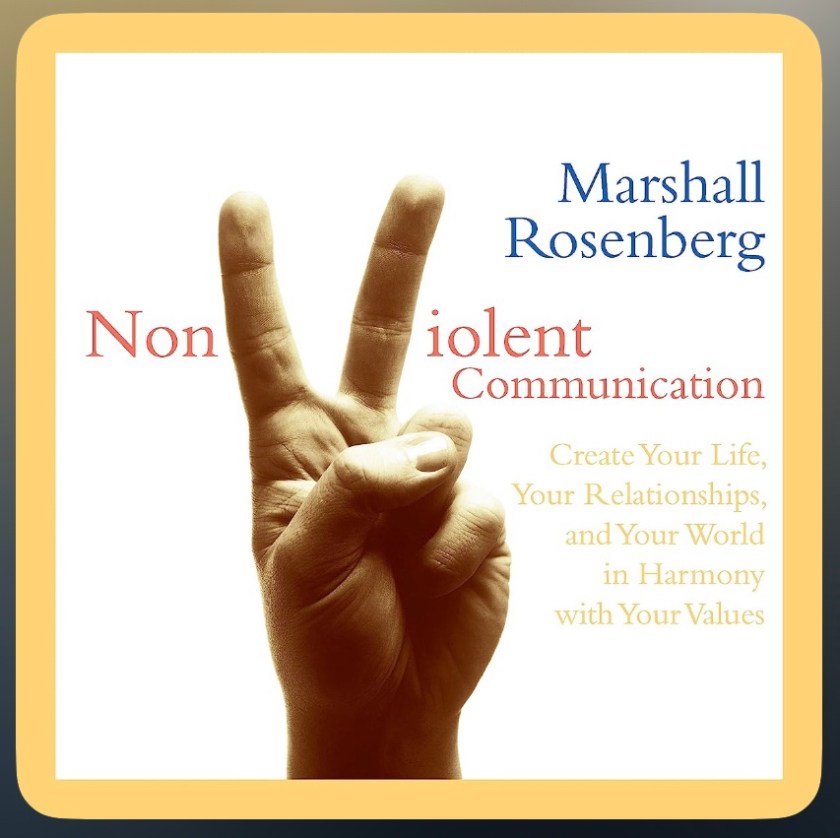
Synopsis:
“What if you could defuse tension and create accord in even the most volatile situations – just by changing the way you spoke? Over the past 35 years, Marshall Rosenberg has done just that, peacefully resolving conflicts in families, schools, businesses, and governments in 30 countries all over the world. On Nonviolent Communication, this renowned peacemaker presents his complete system for speaking our deepest truths, addressing our unrecognized needs and emotions, and honoring those same concerns in others. With this adaptation of the best-selling book of the same title, Marshall Rosenberg teaches in his own words:
- Observations, feelings, needs, and requests – how to apply the four-step process of Nonviolent Communication to every dialogue we engage in
- Overcoming the blocks to compassion – and opening to our natural desire to enrich the lives of those around us
- How to use empathy to safely confront anger, fear, and other powerful emotions
Here is a definitive audio training workshop on Marshall Rosenberg’s proven methods for “resolving the unresolvable” through Nonviolent Communication.” -Audible
~If you enjoy my summary, please consider buying me a coffee via my Ko-Fi link (click the button below) or support this blog in one of several ways! 📖 🎓
I appreciate every donation as it goes directly to the maintenance costs of my blog and creation of new content. 😊

Opening thoughts:
I believe I got this book recommendation from a guest on the Tim Ferriss podcast who mentioned Nonviolent Communication and it sounded very interesting. And I think Tim mentioned that it’s one of his top books or highly recommended books, so it was an easy pick for my next read.
Key notes:
Session One
- The purpose of nonviolent communication is to connect with ourselves and others in a way that makes compassionate giving natural
- Compassionate giving is when we do something for ourselves or others where our sole intention is to enrich life
- Not doing it for reward or to escape punishment, but to contribute to life
- Punishment and reward as a means to influence someone to do something is a losing game
- Punishment reinforces violence as a way of getting what we want. This makes compassionate giving harder
- We really want them to be motivated by the intrinsic value of enriching life, not to get some extrinsic reward from other people
- We need to be able to separate observations from evaluations/diagnosis
- We need to express a true feeling (not evaluation/diagnosis) as well as the reason why and a request from the other person that would alleviate our discomfort
Session Two
- We need to take responsibility for our feelings, that we in no way imply that what others say or do can ever make us feel as we do
- Other people are responsible for their intentions in relationship to us, they are responsible for what they say and do
- We are responsible for how we take it, and how we take it will depend on how we feel
- We shouldn’t express our needs in the form of interpretation or diagnosis of the behavior of others because that can come across as criticism which will cause them to be defensive
- When we have a language of life and a language of needs, conflicts are better able to resolve themselves
- There are basic needs, the need for protection and safety, the need for empathy, and a need for clarity, honesty, to be able to trust what other people say
- The need for celebration, play, rest, creativity
- Need for love
- There’s a need for an accepting community. The need for autonomy. Need for meaning and purpose
- Taking responsibility for the feelings of others can be very detrimental in intimate relationships
- When we do respond to the needs of others, we should do so out of compassion, never out of fear, guilt, or shame
- A request is a reference to a specific person taking a specific action that we hope will meet our needs
- By contrast, needs contain no reference to specific people taking specific actions. Instead, they refer to the life within us that is being fulfilled or not
- Use positive-action language: saying what we do want instead of what we don’t want
- Our requests should be concrete and actionable, not vague
- Depression is the reward we get for being “good”
- But we can enjoy life more by clarifying our needs and being clear on what we’d like people to do to meet those needs
- Requests are a gift, but demands threaten our autonomy
- A demand is something people feel will result in a punishment or negative consequence if not fulfilled
- The objective of nonviolent communication is to establish a relationship based on honesty and empathy
Session Three
- Self-compassion and self-forgiveness free us in the direction of learning and growing
- For activities you feel like you have to do but don’t enjoy, reframe it as “I choose to do ___ because I want ___”
- This will allow you to see that some things aren’t worth doing and you can eliminate them from your tasks
- When we speak a language that denies choice, we forfeit the life in ourselves for a robot-like mentality that disconnects us from our own core
Session Four
- There are alternatives to resolving conflict other than punitive measures or punishments
- Being alive means being in touch with our needs
- Anger tells us that we’re not in touch with our needs
- The first step to fully express anger in harmony with nonviolent communication is to divorce the other person from any responsibility for causing our anger
- It’s not what other people do, but images and interpretations in our heads that produce our anger
- Human growth occurs through a meeting between two individuals who express themselves vulnerability and authentically
- A very important application of nonviolent communication is how to celebrate life through how we express gratitude to ourselves and others
- Expressing gratitude is purely to celebrate, not to get something in return
Closing thoughts:
This was a fairly short, yet concise and impactful read. I’ve heard a lot of good things about this book before I dove in and I believe it delivered for the most part.
I think out of the entire 5-hour listen, it probably had 1 to 1.5 hours of solid content/takeaways. The rest of the 3.5-4 hours was a lot of anecdotes about each point being made, and some repeating points. While I’m not against stories and case studies that serve as examples to deliver the main points, I don’t think this book overdid it the way other personal development books tend to do. Typically, I might see 60-80% fluff in a 12-hour book, when it could have been a 3-4 hour book or a 1-2 hour book with just the points and no examples.
I feel like this is a book most people should put on their reading list because it gives a very solid approach to relationships, communicating our needs, listening to others, and overall resolving conflicts that stem from common communication issues.
One Takeaway / Putting into practice:
There are a handful of really good points in this book that I feel like were not only insightful to me, but I feel like others could really benefit from if they internalize:
- We need to take responsibility for our feelings, that we in no way imply that what others say or do can ever make us feel as we do
- Taking responsibility for the feelings of others can be very detrimental in intimate relationships
This concept of “whose is responsible for whose feelings?” is so important to understand if we want to improve our relationships. Taking responsibility for how someone else feels is so detrimental to any relationship because it not only disempowers them from handling their own emotions, but it burdens you with a task you could never fully fulfill or control.
The same works in reverse when we take responsibility for our own feelings and do not rely on or think we need someone else to make us happy, or not make us sad. It empowers us because only we truly have control of our own emotions.
Nutshell:
Utilizing nonviolent communication is a powerful way to enhance our relationships and resolve conflicts. Using the right language also allows for compassionate giving so that we can enrich the lives around us.
Similar books:
- You’re Not Listening by Kate Murphy
- Atlas of the Heart by Brené Brown
- No More Mr. Nice Guy by Robert Glover
- Boundaries by John Townsend & Henry Cloud
- The Soulful Art of Persuasion by Jason Harris
Rating:
3.5/5
Subscribe for More Summaries👇
Try Audible for audiobooks 📚🎧
Personal recommendation: For the last 9 years, I’ve used Audible to listen to all of my favorite books. It’s easy to use, cost-effective, and they have the best library of audiobooks.
If you use my affiliate links below, not only will you get a special offer, but it’ll help support the costs to maintain this blog! 😊👇
Try Audible and Get Two Free Audiobooks

Please donate! 🙂
Please consider a small donation to help support my blog ^_^ I love providing free book notes and other content. Any donations help me maintain my website and create content consistently. Thanks everyone for the continued support!
$2.00
Discover more from Marlo Yonocruz
Subscribe to get the latest posts sent to your email.

2 thoughts on “Book notes: Nonviolent Communication by Marshall Rosenberg”