Get the audiobook on Audible 👇 (affiliate link)
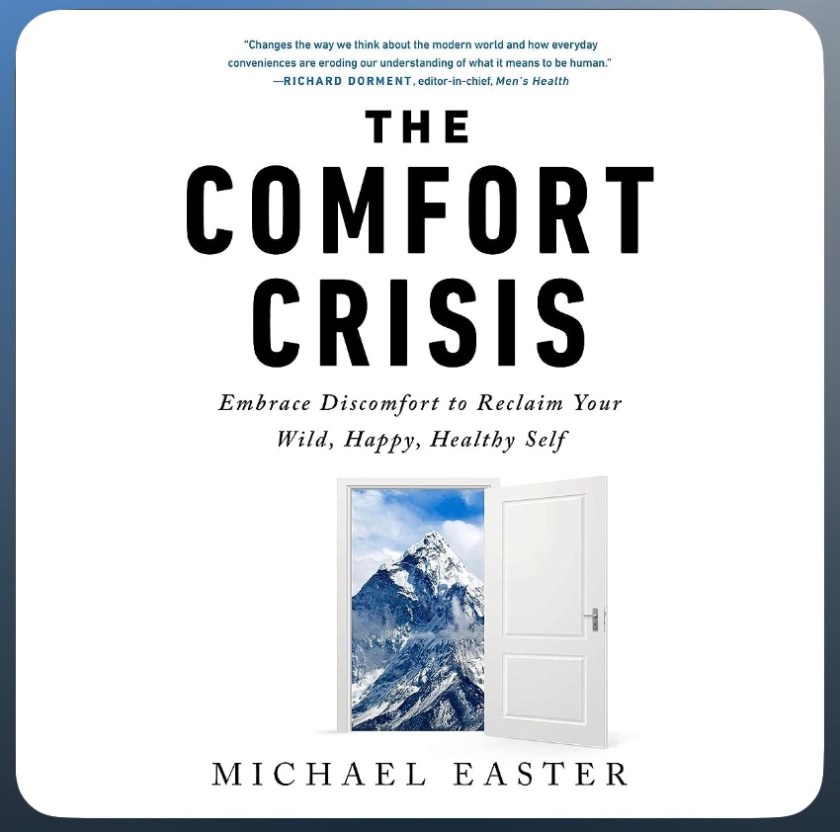
The Comfort Crisis: Embrace Discomfort to Reclaim Your Wild, Happy, Healthy Self by Michael Easter
Synopsis:
“Discover the evolutionary mind and body benefits of living at the edges of your comfort zone and reconnecting with the wild.
In many ways, we’re more comfortable than ever before. But could our sheltered, temperature-controlled, overfed, underchallenged lives actually be the leading cause of many our most urgent physical and mental health issues? In this gripping investigation, award-winning journalist Michael Easter seeks out off-the-grid visionaries, disruptive genius researchers, and mind-body conditioning trailblazers who are unlocking the life-enhancing secrets of a counterintuitive solution: discomfort.
Easter’s journey to understand our evolutionary need to be challenged takes him to meet the NBA’s top exercise scientist, who uses an ancient Japanese practice to build championship athletes; to the mystical country of Bhutan, where an Oxford economist and Buddhist leader are showing the world what death can teach us about happiness; to the outdoor lab of a young neuroscientist who’s found that nature tests our physical and mental endurance in ways that expand creativity while taming burnout and anxiety; to the remote Alaskan backcountry on a demanding 33-day hunting expedition to experience the rewilding secrets of one of the last rugged places on Earth; and more.
Along the way, Easter uncovers a blueprint for leveraging the power of discomfort that will dramatically improve our health and happiness, and perhaps even help us understand what it means to be human. The Comfort Crisis is a bold call to break out of your comfort zone and explore the wild within yourself.” -Audible
~If you enjoy my summary, please consider buying me a coffee via my Ko-Fi link (click the button below) or support this blog in one of several ways! 📖 🎓
I appreciate every donation as it goes directly to the maintenance costs of my blog and creation of new content. 😊

Opening thoughts:
When I picked up this book for the month, I thought it seemed very straightforward. I’m guessing the main idea is that getting outside of our comfort zone is necessary for a higher quality of life, and that the author would provide evidence of that claim.
I think I also chose this book because I subconsciously know that I need to get out of my comfort zone to get out of my own way and achieve the goals I’ve set for myself this year.
Key notes:
Part 1 – Rule 1: Make it Really Hard. Rule 2: Don’t Die
Chapter 1: 33 Days
- Science shows that we’re at our best and become better/rougher after we experience the same discomforts our early ancestors faced every day
Chapter 2: 35, 55, or 75
- He was addicted to alcohol until he had a moment of clarity to start to get his life on track
Chapter 3: 0.004 Percent
- In the modern age, we have modern day, first-world stress
- This is different from what our ancestors dealt with
- Lifespan is up, but health span is down
- The trade off is long-term mental and physical health struggles
Chapter 4: 800 Faces
- A study showed that as we experience fewer problems, we don’t become more satisfied, we just lower our threshold for what we consider a problem
- We end up with the same number of problems; just more hollow
- We are always moving the goalpost
- There is a scientific basis for first-world problems
Chapter 5: 20 Yards
Chapter 6: 50/50
Book reference: Flow by Mihaly Csikszentmihalyi
- 2 triggers for a flow state are:
- It must stretch a persons limits
- It must have a clear goal
- Flow is when you become completely present and engrossed in your work. Your actions and awareness would merge
- Random thoughts, bodily sensations, and even sense of ego and self would fade
- Flow state is a key driver of happiness and growth
- It is the opposite of apathy, and has the potential to make life more rich, intense, and meaningful
- It’s good because it increases the strength and complexity of the self
- Nothing great in life comes with complete assurance of success
- Engaging in an environment where there is a high probability of failure, even if executed perfectly, has huge ramifications for helping you lose a fear of failing and showing you what your true potential is
- Many old human customs have had rites of passage traditions where people would separate from the tribe and be tasked with a difficult challenge
- Toughening phenomenon is the balance between comfort and discomfort that makes one more resilient. A certain amount of stress
Chapter 7: 50. 60. Or 90.
- In newness, we’re forced into presence and focus
Chapter 8: 150 People
- There is a city-country happiness gap, where rural people tend to be happier, though theoretically living in a city would have a higher quality of life
- Dunbar’s number: A group of roughly 150 people or fewer seems to be an ideal community
- Too many people in a small space makes the human brain feel uncomfortable, and this may translate to reduced subjective well-being
Chapter 9: 101 Miles
- Studies show that loneliness and being lonely can shorten your life by 15 years and increase your chance of dying in the next several years
- Good relationships are a key ingredient to happiness and longevity
- It beats fortune and fame
- It’s not a bad idea to occasionally be alone, removed from anyone. Time with yourself unidentified with anything
- Solitude is something people generally suck at
- Building your capacity to be alone probably makes your interactions with others richer, because you’re bringing to the relationship a person that actually has stuff going on internally and isn’t just a connector circuit that only thrives off of others
Chapter 10: <70 Miles an Hour
Part 2 – Rediscover Boredom. Ideally Outside. For Minutes, Hours, and Days
Chapter 11: 11 Hours, 6 Minutes
- Boredom is a desire for desire. So boredom is a motivational state
- Focused mode requires energy, whereas unfocused mode is a necessary resting state where our mind relaxes and wanders
- Lack of boredom causes mental fatigue
- Rule: If you’re not paying for a digital service, YOU are what the company sells
- Boredom makes us more psychologically robust and resilient
- Boredom also allows us to tap into creativity
- Creativity requires us to think on a different wavelength than others. Boredom allows us to do that
- A long-term study showed creativity was a stronger indicator of success and achievement than IQ scores
- Mind-wandering is one of the main drivers of creativity
Chapter 12: 20 Minutes, 5 Hours, 3 Days
- Nature holds the key to our aesthetic, intellectual, cognitive, and even spiritual satisfaction
- Japanese studios show the impact of biophilia and “bathing” in nature
- There are studies that show positive health effects of being in nature
- Soft fascination is a lot like meditation
- It’s a mindfulness-like state that restores and builds the resources we need to think, create, process information, and execute tasks
- It’s mindfulness without the meditation
- A short, daily nature walk
- The ideal quick dose is 20 minutes in urban nature, 3x a week
- The wilder the nature, the better the benefits
- 3-day effect: spending a few days in nature changes your mind for the better
Chapter 13: 12 Places
- Silence in nature is therapeutic and has notable health benefits
Part 3 – Feel Hunger
Chapter 14: -4,000 Calories
- Food insecurity in America is a real thing. However, there is a larger epidemic of too many of us never feeling hungry
- The problem is not fad diets. The problem is our inability to deal with the discomfort of hunger
- There’s a difference between processed (to keep food from spoiling) and junk food, which is less filling and leads to overeating and obesity
- Stress also causes overeating
- People are terrible at estimating portions
- Humans have 2 reasons for eating:
- real hunger
- reward hunger
- Comfort food and stress eating are a leading cause of obesity
- Fad diets fail when the person is met with stress
- Foods are not just a vehicle for delivering energy. They’re often a connection to family, community, culture and identity and should never be off-limits
- Science advocates for a lower-density diet but not too low to trigger binge eating
- Essentially unprocessed carbs, fruits, vegetables, and low-fat protein
- People who eat a diet that focuses on more whole foods experience less disease
Chapter 15: 12 to 16 Hours
- A disconnection with hunger is why most adults gain weight
- Fasting is like a cellular natural selection and gets rid of the old and weak cells which can fight disease and is anti-aging
- Atrophy is the body’s process of “taking out the trash”. Weak links are sacrificed for the greater good
- Our bodies usually crank up autophagy at night to burn through the day’s food and to repair and rejuvenate itself
- Atrophy is the body’s process of “taking out the trash”. Weak links are sacrificed for the greater good
- While hungry, the body’s energy ramps up to give us the drive to find food
- Hunger increases our mental alertness and focus
- Not eating before bed allows you to sleep deeper and better, which gives you better focus during the day
- Occasionally going without food for up to 24 hours is a normal and beneficial state
- Much of our hunger isn’t real, physiological hunger but rather a coping mechanism to comfort us against the discomforts of life
“The harder you work for something, the happier you’ll be about it”
The Happyness Hypothesis by Jonathan Haidt
Part Four – Think About Your Death Every Day
Chapter 16: 3 Good Legs
Chapter 17: 12/31, 11:59:33 p.m.
- Studies show that thinking about death more often allows us to appreciate and find positive things to focus on and makes us happier
- Studies show that countries that tend to drive towards high GPD actually create conditions for more unhappiness, even though it seems like higher happiness for its people is the goal typically
- Well-being is really a byproduct of the interaction between a person’s internal and external conditions
- You can become very brittle and make fatalistic decisions without your internal conditions well-maintained
- Mindfulness is roughly defined as purposefully paying attention to what’s happening in the present moment without judgment
- Knowing that death is coming should change your mental course
- You naturally become more compassionate and mindful
- Your greatest happiness comes from shifts in your mental state
- Thinking about death enhances gratitude
Chapter 18: 20 Minutes, 11 Seconds
- The appeal to nature fallacy is the belief that proposes that anything natural is good, harmonious, and morally correct
Part 5 – Carry the Load
Chapter 19: 100+ Pounds
- People who are able to detach from their negative emotions during exercise perform better
Chapter 20: ≤50 Pounds
- Humans are adapted to be some of the best endurance animals in hot/warm weather
- Carrying is a driving force of why we became apex predators
- Science shows that rucking is strength and cardio in one, and 50lbs is most ideal
- Doing physically hard things is an enormous like hack
- Do hard things and the rest of life get easier and you’ll appreciate it all more
- More physically effortful work usually led to longer lives compared to sedentary ones
- Exercise is the one thing that all scientists agree can improve your health across the board with no adverse effects
Chapter 21: 80 Percent
- Adding a lot of general movement throughout the day can help reduce body pain that many sedentary people develop
Epilogue: 81.2 Years
- Studies have shown that our over-sterilizing world has weakened our immune system as we’re exposed to less good germs and bacteria
- Exposure to cold helps with regulating weight because of brown fat and also increases metabolism
Closing thoughts:
I thoroughly enjoyed this book! Not only did it have very insightful and practical advice, but the overall message was very powerful. It is one of those books that shifted my perspective on comfort vs. discomfort. Other topics that were very interesting included boredom, creativity, fasting, hunger, movement, solitude, relationships, flow, and happiness.
I also really liked how this book followed the narrative of him going hunting in the wild outback and pulling lessons from spending several weeks out there.
Overall, I highly recommend this book to anyone interested in personal development or self-improvement. Or even if they just need a little motivation to improve their lives in small yet meaningful ways.
One Takeaway / Putting into practice:
There are a lot of good takeaways from this book, but the one that I immediately put into practice even up until the writing of these notes is:
- Adding a lot of general movement throughout the day + rucking
For the last 5 weeks, I’ve been on a continuous streak of getting in at least 10,000 steps per day, and have added rucking (long walks with a weighted backpack) to my weekly regimen. Most evenings, especially on my non-strength training days, I’ll spend an hour walking around my gym’s track with about 10 lbs of weight in my backpack for about an hour. It’s very convenient because I can listen to my next Audible book while walking, and I feel like I get more bang for my buck by walking with added weight.
Nutshell:
A strong collection of reasons why being at the edge of your comfort zone and reconnecting with the wild has many positive benefits for your mind and body.
Similar books:
- Peak Performance by Brad Stulberg & Steve Magness
- Atomic Habits by James Clear
- Why We Sleep by Matthew Walker
- The Warrior Diet by Ori Hofmekler
- The Obesity Code by Jason Fung, MD
- Never Finished by David Goggins
- Endure by Cameron Hanes
Rating:
4.5/5
Subscribe for More Summaries👇
Try Audible for audiobooks 📚🎧
Personal recommendation: For the last 9 years, I’ve used Audible to listen to all of my favorite books. It’s easy to use, cost-effective, and they have the best library of audiobooks.
If you use my affiliate links below, not only will you get a special offer, but it’ll help support the costs to maintain this blog! 😊👇
Try Audible and Get Two Free Audiobooks

Please donate! 🙂
Please consider a small donation to help support my blog ^_^ I love providing free book notes and other content. Any donations help me maintain my website and create content consistently. Thanks everyone for the continued support!
$2.00
Discover more from Marlo Yonocruz
Subscribe to get the latest posts sent to your email.

4 thoughts on “Book notes: The Comfort Crisis by Michael Easter”